Key Takeaways
- The Sprint Backlog must visually separate human work items from AI work items.
- Teams restructure their boards by utilizing columns like "AI Generated" and "Human Review".
- The actionable plan must deliberately pace the AI's rapid execution speed against the human team's availability to review the generated code.
- Enforcing these limits prevents a massive pipeline bottleneck of unmerged pull requests.
- Retrieval-Augmented Generation (RAG) can provide vital context to AI agents, but the human Developers retain ultimate planning authority and commitment to the Sprint Goal.
In the Scrum framework, the Sprint Backlog is composed of the Sprint Goal (why), the set of Product Backlog items selected for the Sprint (what), as well as an actionable plan for delivering the Increment (how). It is a highly visible, real-time picture of the work that the Developers plan to accomplish during the Sprint in order to achieve the Sprint Goal. However, when 50% of your development team operates at machine speed, a simple "To Do, Doing, Done" board will inevitably collapse under the volume of work.
To successfully orchestrate a hybrid workforce, the Sprint Backlog must evolve into a highly structured pipeline that clearly separates human work from machine execution and strictly governs capacity limits.
The Visual Anatomy of an AI-Augmented Board
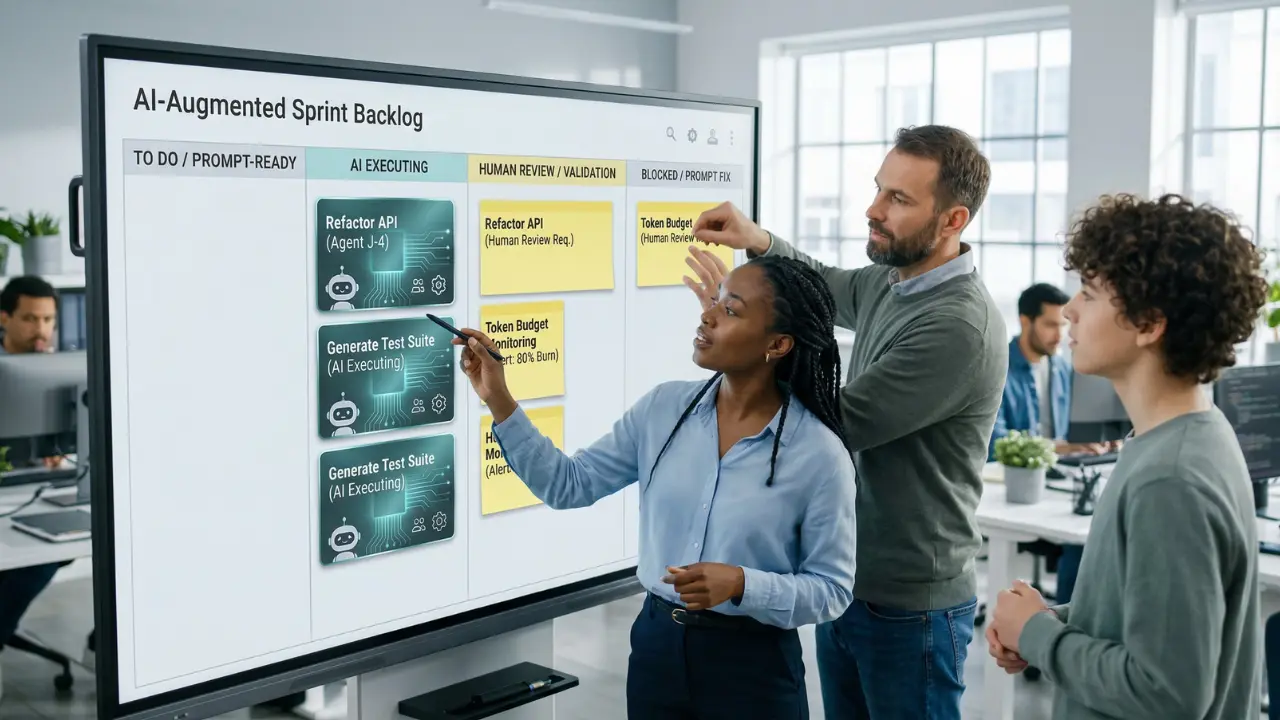
To maintain transparency, hybrid teams must radically restructure their physical or digital boards. The Sprint Backlog must visually separate human work items from AI work items, utilizing columns like "AI Generated" and "Human Review".
Instead of assigning standard tasks, sticky notes and tickets are explicitly labeled as "AI Agent Task" to clearly identify machine ownership. Here is how a standard workflow state changes in an AI-Augmented Sprint Backlog, integrating common columns (ToDo, Coding, Test Cases, Peer Review, Testing, Documentation, Ready for PO Review, Done) with machine execution paths:
- To Do / Prompt-Ready: Tickets contain highly structured technical requirements rather than vague user stories.
- Coding / AI Executing: Operates parallel to human coding. The bot is actively consuming API tokens to write code or execute tests.
- Code Review / Human Validation: Inserted before standard Peer Review. A human developer actively evaluates the AI's output and confidence scores.
- Peer Review & Test Cases: Standard human-driven practices resume once the AI output is validated by the managing developer.
- Blocked / Prompt Fix: If the bot fails at any stage, the ticket cycles back into a "Prompt Fix" state for the human developer to refine.
- Testing & Documentation: Standard testing procedures and documentation updates occur, optionally augmented by AI re-prompting.
- Ready for PO Review & Done: The Increment is complete.
Aligning AI Agents with the Sprint Goal via RAG
The Sprint Goal is the single objective for the Sprint. Although the Sprint Goal is a commitment by the Developers, it provides flexibility in terms of the exact work needed to achieve it. Because AI agents lack a strategic understanding of product value, they cannot independently align themselves with this overarching goal.
To shift the burden from purely manual human prompting to an automated process, high-maturity teams use Retrieval-Augmented Generation (RAG). RAG allows AI agents to pull the broader context of their tasks automatically:
- Dynamic Context Injection: A RAG-enabled agent retrieves the current Sprint Goal, Product Vision, and Definition of Done from a vector database before executing its work, grounding the output in the "why" of the sprint.
- Automated Pre-Validation: Before an AI agent moves a ticket into the "Human Validation" column, it uses RAG to query its generated code against the Definition of Done. If it detects misalignment, it can attempt a self-correction.
Crucial Caveat: RAG provides context, but humans provide commitment. The vector database must be curated and maintained by the Developers. As the Developers work during the Sprint, they keep the Sprint Goal in mind. If the work turns out to be different than they expected, they collaborate with the Product Owner to negotiate the scope of the Sprint Backlog within the Sprint without affecting the Sprint Goal.
Agentic Capacity vs. Human Bottlenecks
The Sprint Backlog is a plan by and for the Developers. Does this mean we allow AI Agents to plan their work? Absolutely not. Therefore, the human engineers must architect this plan to protect themselves. The most critical operational risk in hybrid team planning is pacing. The actionable plan must deliberately pace the AI's rapid execution speed against the human team's availability to review the generated code.
An autonomous agent can easily generate 10,000 lines of functional code overnight. If your human developers only have the daily capacity to securely review 1,000 lines, the agent becomes immediately blocked.
If you fail to plan for this human limitation, the pipeline stalls, and technical debt accrues instantly in the form of unmerged pull requests. During planning, you must strictly limit the total agentic capacity to match the human code review capacity. Do not let the bots outpace your human quality assurance capabilities.
Tracking Daily Progress and Deviations
Consequently, the Sprint Backlog is updated throughout the Sprint as more is learned. It should have enough detail that they can inspect their progress in the Daily Scrum. Because AI agents run 24 hours a day, the Sprint Backlog is updated throughout the Sprint as more is learned. To ensure the board remains a highly visible, real-time picture of the work that the Developers plan to accomplish during the Sprint in order to achieve the Sprint Goal, you must enforce automated tracking. It should have enough detail that they can inspect their progress in the Daily Scrum.
- Automated Log Appending: When an agent completes a task, it should automatically move the ticket across the digital Scrum board and append a summary of its actions.
- Immutable Audit Trails: This summary must include the exact files modified, the libraries imported, and the tests executed.
- Token Budget Monitoring: If the team has burned through 80% of their API budget by day three of a two-week sprint, the Scrum Master must immediately halt the agents and re-evaluate the technical prompts driving up the compute costs.
Frequently Asked Questions (FAQ)
What is an AI-Augmented Sprint Backlog?
It is an artifact composed of the Sprint Goal (why), the set of Product Backlog items selected for the Sprint (what), and an actionable plan for delivering the Increment (how), adapted to visually separate human work items from AI work items.
How do you set up the columns on a hybrid Scrum board?
Teams must move away from simple "To Do" and "Done" states and instead utilize columns like "AI Generated" and "Human Review".
How do you prevent AI from overwhelming the human developers?
The Sprint plan must deliberately pace the AI's rapid execution speed against the human team's availability to review the generated code. You must strictly limit the total agentic capacity to match the human code review capacity.
How do bots update the Sprint Backlog?
When an agent completes a task, it should automatically move the ticket across the digital Scrum board and append a summary of its actions.
What happens if an AI agent generates incorrect code during the sprint?
If the bot fails, the ticket cycles back into a "Prompt Fix" state for the human developer to refine.
Do AI agents plan their own work?
No. The Sprint Backlog is a plan by and for the Developers. Human engineers must explicitly architect the plan to protect themselves and dictate the agents' workload to prevent pipeline bottlenecks.
Can RAG keep AI agents aligned with the Sprint Goal?
Yes. Retrieval-Augmented Generation (RAG) allows agents to dynamically retrieve the Sprint Goal, Product Vision, and Definition of Done before coding, providing context. However, humans retain ultimate commitment and must maintain the underlying vector database.